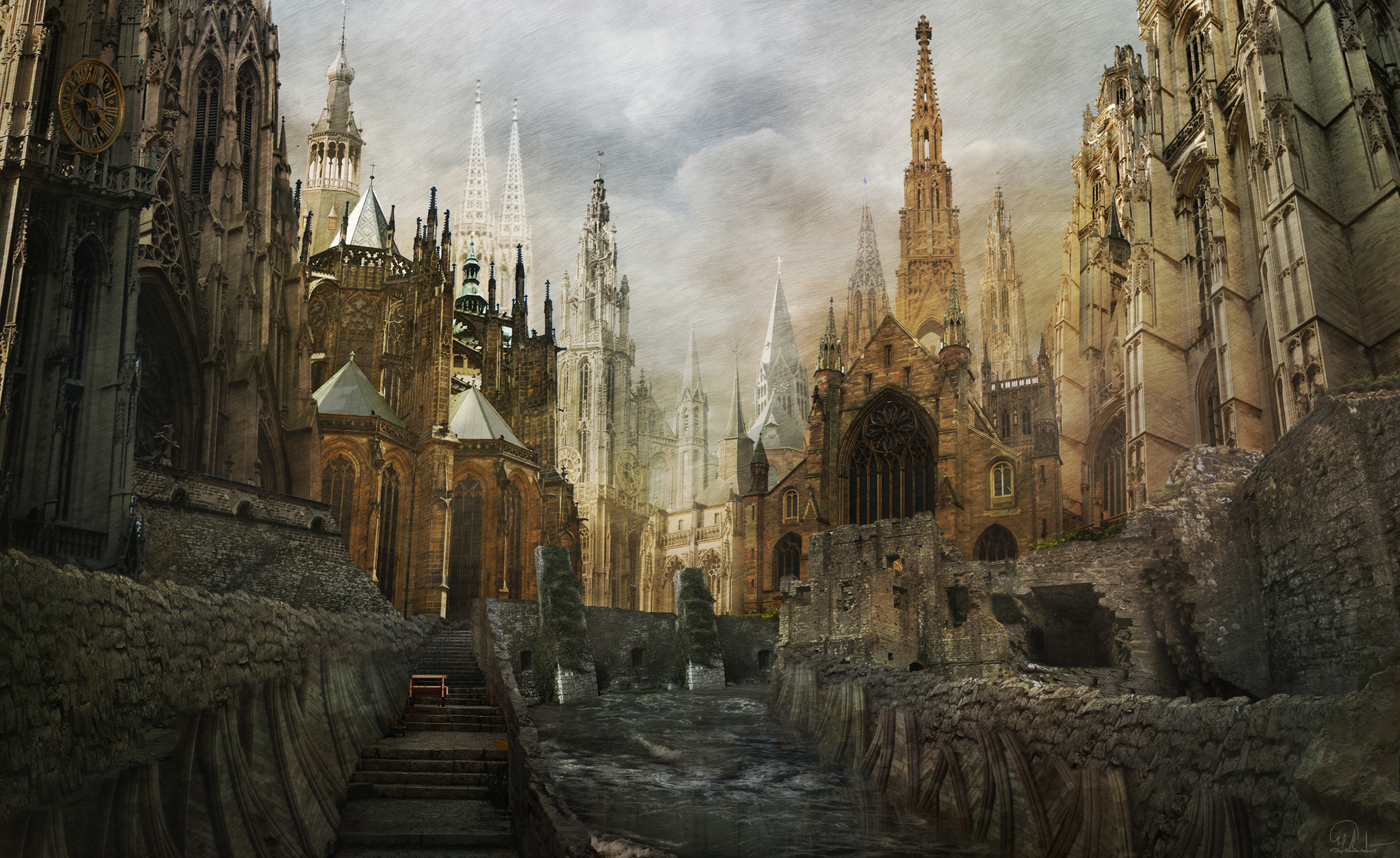
Sunday, November 3, 2019

Melinya Culture Focus: Western Alahbmah


Lay of the Land
A massive series of salt pans and shallow lakes rarely deeper than two feet. The ridges between the features and some pans are covered in thick and vibrant red moss and lichen. Other colours exist, and are visually striking when mixed. The mineral deposits in the frequently dry pans can conceal dangerous, acidic mud pockets, which the natives are familiar with enough to avoid. The eastern border consists of an abrupt and massive mountain ridge that cuts off access to the rest of Alahbmah, of which none live because of the cataclysmic conditions that continue unabated. The mouth of the one river that breaks through the ridge is struck nearly continuously by lightning.

Major Cities
At 300,000 sq km in size and a population of barely a quarter million, it can be literal days before one sees a settlement. Buildings are constructed of mud and mineral sheets, visible for miles because of the flat terrain, built to only accommodate an extended family. Most settlements are extended families herding several iccu and harvesting edible moss, and can go months between contact with others.

Alignah is the most urban settlement, where eight of its ten thousand residents live in the Palace of Alignah, a literal labyrinth. Formerly the home of the Mad King Nedoh, it was donated as a monastery after his conversion to Celmsim, serving as the home for the August Guru and center for the entire Celm faith.

Economics
Subsistence moss-farming and iccu herding are the dominant activities, resulting in a largely self-sustaining population with little need for trade or money. Greater than normal harvests can lead to excess iccu, traded with pilgrims and iccu traders.

Law & Order
As the dominant religion throughout the known world is Celmism, Western Alahbmah’s chief export is religion. Donations and converts divesting themselves of their material fetters from across the nations serve as the primary source of economic activity, including the construction of monasteries for a guru.

In families, the family member with the most monastic experience is generally the final arbiter for disputes except for situations of punishment, which require travel to the nearest to confer with a monk. As Celmism forbids killing, hindering or depriving a sense is the most common form of punishment, other punishments including a period of sensory deprivation for bogies to punish them.

Government
A full Cemlite theocracy, the August Guru nominally holds influence well beyond the borders of Alahbmah. Amongst the lay folk, temporary devotion to monastic study is performed in response to most significant life events; naming, childbirth, engagements, momentous financial events, etc.

Sunday, October 27, 2019

Melinya Culture Focus: Tii


Lay of the Land
A massive peninsula, the continental border lined with perilous mountains. The mainland is predominantly lush, rolling hills and thick forests of idyllic weather conditions.

Much of the coastline near the continent is dangerous for ships because of the sharp, barren rocks and shallow islands. Farther out on the peninsula, the coast becomes calmer and friendlier to larger ships.

Major Cities
By far the most populous nation, with ten million people, Tii is a naval powerhouse and the breadbasket of the known world. Visitors usually first encounter Tii through Chalea, the trading hub at the Great Road where it passes through the mountains; an almost lawless city due to complex treaties with the barbarian kings of the mountains. These same barbarian kings also command influence over Shard Pirates that live in the dangerous waters near the peninsula.

Mirroring Chalea on the far side of the nation is the port & capital Linnea, where the multi-nested palace monastery dominates. Each of the Great Houses of Tii send their own for monastic study and at least nominally designated as monks for life; many swearing to the Solipsistic Precepts, a variant on the Chelm ethical code that permits killing.

Economics
With the rich and developed agricultural infrastructure, Tii’s premiere export is food. Their triceratops herds provide huge meat reserves. Tii-breed chocobos are renowned, and the Tii cavalry see yearly competitions with international acclaim. As part of the syncretic absorption, skulls are featured heavily in religious and cultural activities, and are in sufficient demand to sustain a strong market for import. When sufficiently used, the skulls are recycled at the bone mills to produce high explosives.

Law & Order
The Solipsistic Monks serve as the dominant demographic for military and civilian law enforcement. Individual villages are controlled by council of descending representation: monks, nobles, and commoners; each council answering to the House Lord for their territory. In disputes between nobles and commoners, the noble is obliged to compensate the commoner several fold the damages inflicted upon the commoner, while the commoner’s obligated only proportional compensation. Disputes between equals are generally resolved to favor equilibrium.

Religious law concerning bogies can get esoteric, such as no consumption of honey less than an hour before performing any business transaction, but they are only enforced on holidays. On such holidays, many stay indoors to nominally cleanse their minds of potential bogies.

Government
A Cemlite theocracy in all but name, the gurus of Linnea act as advisers with absolute veto power over the king and each of the House Lords.

Sunday, October 20, 2019

Melinya Culture Focus: Gallina


Lay of the Land
The fjords are angled and crowded to the banks of the river with agricultural terraces. The sky is pregnant with smog from industry and have a glow even at night from the lights below. To the casual visitor not a single acre is untouched by civilization.

The noncasual visitor will find the snowy peaks of the land the closest thing to virgin territory, but they will not visit long, as the storms and snowfall is nearly continuous.

Major Cities
Kuyam is also known as the Nine Ways City, its megalithic roadways spiraling out like spokes in a wheel across the known world. This metropolis, spiraling upward as much as it sprawls outward, dominates everyone’s view of the nation. Even the aqueous miners of Ayinaa & bureaucratic distributors of Itanik, both sizable cities in their own right, consider themselves as Kuyamics living abroad. Of course, if they didn’t, their economic ventures take an inexplicable nose-dive and few wish to tally themselves before the Writ.

After millennium under the rule of the All-Father, the cumulative architectural accomplishments make the three metropoli of Gallina megalithic, and continue to grow to accommodate the influx. Even the ruins of Azdas have yet to be dented from the company using it as a quarry.

A fraction of the size of the three main cities is the military farm Azdawa, where the unique ironroot is grown for use in paper mill for printing money, as is the byproduct used in the classified recipe for high explosives.

Economics
Originally the capital of the All-Father, Gallina is first and foremost a trade economy. While its banking system isn’t as advanced as that found in Aikoh, it makes up for it in size, which gives it a particular resilience to economic shakeups.

Law & Order
To be a citizen is to be a civil servant, and vice versa. After the Long Holiday, the vast majority of government employees work in a manner not unlike the USA’s National Guard. To the common citizen, the budgetary control office (the Writ) is the most feared branch of the government. Criminal enterprise apes the general structure of the public sector, except for the Solar Bear Gang, which is a dangerous drug-trafficking gang that continues to follow the indigenous religion that claims to predate the arrival of the All-Father.

Government
A republic that is run as a corporation for its standard operations, the Board of Directors being the only elected positions. In the founding document that remains enforced, no elf of greater than 1/16 purity is permitted to hold position in the Board of Directors or as head of any department, and so heritage records going back four generations to prove this claim are required.

Sunday, October 13, 2019

Melinya Culture Focus: Rotak


Lay of the Land
A plateau with 450 meter tall cliffs on every side and a 60,000 sq.km. footprint, this clouded nation is known for its distinctly violet ironwood trees, two meter mushrooms, baby pink lakes, and the single immense ramp of the Great Road leading up to it. The terrain is diverse, with swamps and ravines scattered about.
Game other than birds is scarce, but the flora is proactive, especially near the edges of the plateau and the cities.

Major Cities
About 80% of the two million Rotakans live in the three dozen cities along the Great Road, many agrarian. The other 20% live on scattered royal estates and isolated villages where serfs are simultaneously at their most independent and short-lived.
The architecture is best described as bygone & robust.

Economics 
More elves than any other nation, Rotak commands a large number of master artisans and the best apprenticeship programs of any trade or craft in the known world. Cobblers, mercenaries, smiths, and more come to learn their vocation with a contractual obligation to send a small portion of their future earnings for a time after their training.
Of note is the Blanket of Rotak, where the heavy taxation is redistributed to tenants and citizens as befits their need. This is a formalized form of the long-standing gift culture.

Law & Order
The Guard is the most public and iconic branch of the nation, the laws they enforce artistically displayed in gold filigree on statues in the Great Hall of Mandates. Custodians maintain the quality of public property, and strive to be unobtrusive. Few know that the Custodial Department is the largest employer of citizens in the country.
Of particular note is the frequent national holidays celebrating events related to Rotak’s independence and successful conquests (officially classified as civil war) of the lowlanders.

Government 
The oldest nation since the death of the All-Father (of which several elders are old enough to remember fleeing to Rotak as children), and considered the birthplace of democracy. Universal suffrage is granted at age 64, with mandatory participation. Even foreigners are granted citizenship with thirty years of residency. The government is run by a parliament proportionally elected by local councils that themselves are elected by their constituency.
There are functionally three castes; citizens, tenants, and serfs. Serfs make up the majority of the population, and are legally public property (slaves of the state). Tenants are residents that do not yet have citizenship, and so cannot participate in government nor exercise control over serfs, but otherwise have the same rights and protections as citizens.

Wednesday, October 9, 2019

[3.X] Tomb of the Doomed One: A Sidequest


Tomb of the Doomed One

Regdar leans against the stone wall, sliding down it until he sits in defeat against the masonry. "How much farther does this lich's dungeon run? Ye told me the Doomed One's tomb was a small one. I swear, if I have ta fight one more dire rat..."

"Quiet Regdar," hushed the tall elf, his bald head slicked from humidity of the corridors, "...I already told you that we have not reached his tomb yet, this is merely the remains of his city we traverse. The entrance to his tomb should be just around this..." Glaur mumbles off just as his head peeks around the corner.

"Blast yer premonitions Glaur, did ye see another lass pine fer her true love?" Propping himself up by his axe, Regdar stands and strides to face the stammer's cause. It seemed a courtyard, with a small monument in the center of the entrance to the Doomed One's tomb, the slick moss draped over the ruined city. It was dry however, at the border to the tomb's entrance itself, cobwebs drooped across. The skeleton of a glabrezu lay just within the confines of the tomb's entrance, it's pincers outstretched before it, and heavy grooves line themselves out and into the courtyard; as if the tanar'ri were dragged back in.

Physical Description: The Tomb of the Doomed One is to be the final portion of an otherwise fully active dungeon of the DM's choice, with the expected dangers already overcome by the party. By all appearances, this is your typical dungeon tomb, full of traps and immortal guardians waiting to destroy any who dare to violate its sanctity. However, the dungeon itself is in ruins. Traps lay in open disrepair, inspection revealing that many of the components rotted from the inside. Golems, fiends, and normally eternal creatures who seek not food nor sleep are all destroyed. Their remains in positions of defeat, as if they had begun to wither from the inside and could do nothing to fight.

Catalyst/History: Long ago, there was your typical master of the arcane who took over his city with an iron fist. Seeking immortality, he turned to the powers of lichdom, and as time passed, he spent less time ruling in person, leaving the duty to his minions. For sanctuary, he built a tomb in the center of the city, his studies conducted within the bottom of the dungeon. It was built as a maze to confuse any intruders that attempted to disturb him, and many a trap was built to further eliminate adventurers. As time went on, his city fell into ruin, but the lich had long since given up the desire to rule and only sought to study and stop intruders. His dungeon became more dangerous, and famous for its supposed treasure within.

Untold numbers of adventuring parties have attempted to storm the dungeon and obtain the treasures within. But time after time, yet another team of intrepid adventurers went into the dungeon only to meet their end. The dungeon had become infamous for its dangers, and the rumours of its treasure only inflated with it. Thus, the deaths continued in their horrible fashions. However, all things must end, and the toll of deaths grew too great for adventurers to risk venturing forth.

Something happened since that time though. The souls of the adventurers lost within the dungeon are countless, and their pain great. Eventually, the collective wrath of the parties lost got too great for even the lich to contain. Limitless, formless wrath rose up and took its vengeance upon both trap and guardian. Nothing survived, and even the lich was sundered. However, their lost lives remain unfinished, and remnants of the horrors seen within the dungeon remain. Some of the spirits are still trapped, reliving their last moments while the ruined traps retain a palpable horror to them.

Alignment: Neutral Evil is the dominant alignment. Unfettered wrath and angst from the lingering spirits that died within, combined with the feelings of loss and hopelessness make the dungeon feel like one has entered a microcosm of the Gray Waste of Hades. In fact, the crushing despair and agony from the spirits of the slain adventurers continue to weigh heavily on the psyches of any who enter, as listed below for long-term effects.


Rumours: Gather Information (DC 25) will reveal the historical elements of the tomb (Bardic Lore DC 20), as far as why the tomb was constructed and its bloody history. The fact it's now dead and haunted is not a fact known to anyone by this point. Information of historical value can be gleaned through the writings found in various situations (particular binding circles, bloodied transcriptions of someone's last words, etc), but the age of the place as well as deterioration will require a Decipher Script (DC 25) or so to understand.


Encounters: Many of the encounters of this dungeon are more flavour descriptions, as is shown by a few examples below. The order they are encountered in is up to you, as the actual layout of the dungeon is fairly freeform. In order to prevent the dungeon from being too much of a good thing, as it were, it is suggested that you try not to have too many more encounters such as these.

  • A room with a handful of stone golems, either broken in half or significant portions fallen off. Attempts to examine the remnants show that they are mere sandstone, crumbling in the adventurer's hands like sand.
  • A plain hallway with a pit in the center, the trap door swinging loosely open. Those that look for the first time at the bottom the pit trap will see a still living person impaled upon a barbed spike, blood flowing and arm reaching for the person who looks. Any who attempt to climb down and get a closer look will find the vision changing, and see that it is actually an old skeleton with a locket wrapped around its hand (its image aged into obscurity)
  • Coming upon a closed iron door, a careful rogue will find a swinging scythe trap. But whether he attempts to disarm it or the party trips it, the result is the same. The scythe will come out of its slot, and fall to the ground, the metal rusted from the inside.
  • Screams bellow from the room ahead, those that look see a vampire holding a battered human mage that only screams. The vampire leans against the wall, releasing a green cloud that causes the human's face to break into boils, eventually the screaming stops due to swelling in the throat. If the party tries to open the door fully to stop the vampire, the scene will change, and the vampire will be alone and leaning against the wall, face withered and eyes glazed over with lifelessness.
  • Several of the spikes on the broken traps still have their poison on them. The centuries of neglect have caused them to fester and mutate, becoming small spore colonies of several types of disease, Slimy Doom being the most dangerous among them. Feel free to include a lone colony of yellow mold in one of the broken pits or in the corner of a room where a fungoid monster used to be.


In order to spice up the dungeon, more active remnants of the horrors from before remain...

  • Before the encounter, have the party make a Will save such that only one is likely to succeed at. Entering an otherwise empty room, a creature of a CR roughly 7 higher than the party's average level enters through a secret door. The creature, immune to fire, will set off a trap that fills the room with flames that damage the party for about 2d6 per round, on top of the attacks the creature will levy forth upon the party until all have fallen (along with much boasting of its supremacy). The party will then awaken, realizing the encounter to be only a quasi-real illusion that deals subdual damage. If one of the party members either makes the save or was is immune to illusions, then they get to watch the party scream at nothing and fall unconscious.
  • A slightly more vibrant room, there will be a tough monster remaining, attacking the party (roughly CR = party level + 3 or 4). However, 2 rounds into the fight, the damage will be revealed as fake (not even subdual damage) and the monster will get attacked by the collective spirit of dead adventurers from prior forays. Blue soul-stuff seeps from the masonry cracks, surrounding the creature and pulling it against the wall. Faces of wrath can be seen in the ephemeral smoke while they howl, causing the creature's ears to bleed while it's vital force is seen drained away until it lies motionless. The room's colors will fade to the usual color, and the drained creature will remain, almost totally untouched from the moment it was destroyed in the vision.


Treasure: The actual treasure of the dungeon is the lich's stash, famed and coveted by all of the adventurers that dared to enter and failed horrifically. It has, of course, been exaggerated in value, but remains of some significance to the party. Once to the bottom of the dungeon tomb, they will find a lich seated in a formerly lavish chair before its desk, its face one of horror and the body 'lifeless'. If they disturb the lich at all, soul-stuff (see last example encounter above) will rise from the body of the lich as if smoking. Its body will jerk artificially to face the party, and speak a cryptic riddle, sounding like a chorus of thousands speaking in unison.

You can use whatever is appropriate here, but it is suggested for the room to have astrological diagrams covering the walls and the riddle be "Born with the world, destined to live as long as the world, and yet never five weeks old.". The mechanism to uncover the treasure will be where the moon should be, as it is intentionally removed from the diagram. Thus, you need to figure out both the riddle and make a Knowledge (astronomy) check (DC 15). As most will not have ranks in astronomy, Knowledge (the planes) can be substituted at a +5 to the DC.

The actual treasure itself should be a variety of nonmagical, yet lavish, scepters, jewels, and velvet bags with diamond dust. All of these items are components for the various spells of the lich (jade circlet, etc), and are worth in total equal to the average treasure award for an encounter roughly 4 higher than the average party level. For example, a level 6 party will find 7,500gp worth of treasure.

The lich's tomes and spellbooks have been destroyed with him, due to age. However, a couple golden medallions are inscribed with highly complex geometries and symbols, containing encoded spell script. Learning spells from here are as from a normal spellbook, only the DC is +10 due to complexity.

Long Term Effects: This is a quality few adventuring parties will experience, but if they attempt to stay too long within it, they might succumb to the mental horror of the dungeon tomb. In a manner similar to the Gray Waste of Hades, every day spent within the dungeon requires a Will save (DC 10+total number of days in tomb). Failure will result in the player's mind being crushed beneath the weight of horror, pain, agony. His eyes will become dead, his mannerisms will be paranoid (as if the tomb was still active), and attempts to leave the dungeon tomb will cause blue soul-stuff to rise from the cracks and consume the character.

Sunday, October 6, 2019

Melinya Culture Focus: Axphain


Lay of the Land 
Aside from its signature Three Mountains of Ten Thousand Pillars, Axphain is dominated by innumerable wetlands. Mangrove forests, fens, mires, bogs, seasonal marshes, and more are scattered about and the local dialect has a disturbing number of different words for ‘mud’. Rivers both fresh and salt water twine through much of it, the tree cover making Axphain perilously easy to get lost in. The wildlife is incredibly diverse and none have fully catalogued what creatures can be found, the most well-known being stilt-beasts, crocodiles, & muck hounds.

Major Cities
The second most populous nation, with eight million citizens, there is a serious problem of overpopulation. The wetlands are very sparsely populated, predominantly family units eking out a subsistence living with the occasional wealthy manor estates. Much of the rest of the population stays in the sprawling, crowded, mountain cities. By far the largest congestion is in Kaivitu, home for the Empty University, the premiere institution for higher learning in the known world. There are two other auspicious academies elsewhere in the nation, the University of Desolation in Marakku, and the Seventh Academy of Nugae. Each of the cities are multi-story, congested, and beyond the walls of the institutions of higher learning, incredibly poor.

Economics 
The rural estates form a large backbone of the nation’s industry, harvesting medicinal plants & insects for refinement in the cities. Renowned hospitals and doctors scattered in the urban centers foster a vibrant source of income from wealthy foreigners seeking treatment, and the academic elite forged here is the forefront of culture and art throughout the known world.
The latter two have created an economic disparity that is truly stark. Of the lower class able to find work, it’s predominantly dirty and menial labour both harvesting and refining medicines, along with associated goods subject to a detailed division of labour. The academic elite (including medical doctors) live a privileged life sheltered from their economic lessers.

Law & Order
Guilds form the backbone of order for those traveling, regulations are strongly focused on protecting economic assets and fines being the preferred form of punishment. Prisons are discouraged, but those working off their fines in the rural estates will laugh at those who say this.
While many of the titles are derived from the Chelmite orders, students (even alumni) and faculty are not religiously backed. They do enjoy effectively diplomatic immunity, any crimes are resolved through their University’s internal chairs.

Government 
A dual-Parliament; the Council Elect, comprised solely of tenured professors from the Academy, and the elected of the Council Vulgar, whose members are publicly elected.

Sunday, September 29, 2019

Melinya

I've been away from my blog, but I've got material I want to work on. Six nations, their cultures, and their nature.

Magic

Essentially none. There are priests, but no clerics. There are academics, but no wizards. Superstition is treated literally, as tall tales in an attempt to explain the unexplained. This isn't to say there aren't fantastical elements - there are the Alahbmahn iccu, giant centipedes that feed off minerals and heavy metals, and a strain of nonhuman heritage flows throughout the people of the six nations. Modernization has begun to rise, with the invention of gunpowder to the mad science of Axphain's medicine.


Race(s)

There are two. Humans and Half-elves. Those with elf heritage do so only through descent from a historical figure known as the All-Father. To be half-elf is to be descended from this figure; though the term is a misnomer, as one is considered a half-elf if you claim as little as 1/16th the blood of the All-Father. Culturally, being a true half or even quarter elf is to be considered "noble"; and the concentration of this heritage is plain to onlookers, from the greatly extended lifespan to lesser talents possessed by their legendary ancestor.


The All-Father

Well over two millennium ago, a mysterious figure known only as the All-Father came and conquered all of Melinya to rule as Emperor. This was the only elf the world had ever seen, and his rule was absolute. Primae Noctis was enforced throughout the great kingdoms of the Empire, thus ensuring his bloodline was spread throughout all of the royal lines throughout Melinya.


Birth of the Nine Ways

Three centuries ago, civil war broke out, and saw the death of the All-Father. As the dust settled, the people of Melinya branched off and founded their own nations in the remnants of the once-unified empire. Naturally, this was not to remain stable, as the names and borders of the original nine nations have shifted. Three of them, in fact, have fallen and their people and territory were claimed by the victors.